Africa at the Crossroads: From Conferences to Confidence
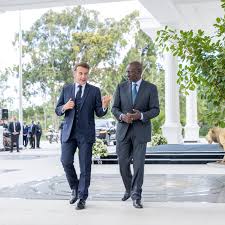
Every year, Africa hosts high-level international conferences. Heads of State gather, cameras flash, declarations are signed, and speeches promise a brighter future. Yet for millions of Africans, one question remains unanswered:
What has truly changed?
Not long ago, France convened a major engagement with African leaders in Nairobi, Kenya. A few months later, another gathering brought African leaders together in Paris. These meetings were presented as opportunities to strengthen partnerships, expand investment, discuss security, climate change, trade, innovation, and Africa's place in the global economy.
But across villages, towns, cities, universities, boardrooms, and social media, ordinary Africans continue to ask difficult questions.
What exactly was achieved?
Where are the factories?
Where are the millions of jobs?
Where is the technology transfer?
Where are the industries that should transform African economies?
If Africa possesses nearly every strategic mineral the modern world depends on, why do many African countries continue to export raw materials while importing expensive finished products?
If Africa feeds much of the world with its agricultural potential, why do millions still struggle with food insecurity?
If Africa has one of the world's youngest and fastest-growing populations, why are so many young people risking dangerous journeys in search of opportunities abroad?
These are not questions of pessimism.
They are questions of accountability.
Kenya's Growing Voice
President William Ruto has increasingly positioned Kenya as a diplomatic and economic bridge between Africa and the rest of the world. His administration has consistently argued that Africa deserves fairer financing, better access to global markets, climate justice, and stronger partnerships based on mutual respect rather than dependency.
Kenya has become an active host of international summits and a visible participant in global discussions on finance, technology, peace, and sustainable development.
Many Africans welcome this visibility.
Others ask a more practical question:
How will these international engagements improve the lives of ordinary Africans?
Diplomacy matters but citizens also hope to see measurable improvements in employment, industrial growth, education, healthcare, infrastructure, and local manufacturing.
South Africa's Continental Leadership
South African President Cyril Ramaphosa has similarly advocated for stronger African representation in global decision-making and has consistently called for reforms in international financial and governance institutions.
South Africa remains one of Africa's largest industrial economies and has often promoted greater regional integration through the African Continental Free Trade Area (AfCFTA).
His message has frequently emphasized that Africa should negotiate with global partners from a position of confidence and shared interests.
The vision is clear.
The challenge is implementation.
Africa's Greatest Resource Is Not Underground
For decades, conversations about Africa have centered on gold, Diamonds, Oil, Copper, Cobalt, Lithium, Rare earth minerals, yet Africa's greatest resource may not lie beneath its soil. It walks its streets every morning. Africa has engineers capable of building world-class infrastructure, Scientists developing life-saving innovations, Farmers feeding millions under difficult conditions, Doctors working with limited resources, Teachers shaping future generations, Entrepreneurs creating businesses from almost nothing, Software developers building globally competitive technology, Artists whose music dominates international charts, Athletes inspiring the world, Researchers solving local challenges, Young innovators designing solutions using artificial intelligence, renewable energy, robotics, biotechnology, and digital finance.
The continent does not suffer from a shortage of talent, it suffers from insufficient opportunities to fully harness that talent.
From Dependency to Partnership
The question is not whether Africa should engage with Europe, Asia, the Americas, or the Middle East.
International partnerships remain essential in today's interconnected world.
The real question is whether those partnerships enable Africa to build greater self-reliance.
Partnerships should help African countries strengthen local industries, develop skills, expand manufacturing, improve research, and create value from their own resources, not simply export raw materials and import finished products.
A stronger Africa benefits both Africans and global partners.
The Africa We Can Build
Imagine an Africa where lithium becomes African-made batteries, where cocoa becomes African-produced chocolate, where cotton becomes African fashion brands, where crude oil becomes refined fuel and petrochemicals produced locally, where universities lead scientific discoveries, where technology hubs create solutions for global markets, where African airlines connect African cities more efficiently, where regional trade flourishes because borders facilitate commerce rather than hinder it.
This vision is ambitious but not impossible.
A New Generation Must Lead
Africa's future will not be determined only by the speeches delivered in conference halls.
It will also be shaped by the ideas developed in classrooms, workshops, laboratories, farms, startups, factories, and communities across the continent.
Leadership matters, investment matters, policy matters, but so do innovation, integrity, education, entrepreneurship, and a commitment to solving African challenges with African expertise.
Perhaps the question is no longer: "What will the world do for Africa?" Perhaps the more important question is: "What can Africans build together for Africa?"
The future of the continent may ultimately depend less on the conferences held abroad and more on the confidence, collaboration, and determination found within Africa itself.
Africa has the resources.
Africa has the people.
Africa has the ideas.
The next chapter will depend on how boldly those strengths are transformed into lasting prosperity.
Comments
You must be logged in to post a comment.